
Last Updated: November 2, 2026
Quick Summary
Sustainable luxury travel in Jamaica is worth it in 2026 when you verify specifics rather than trust brochure claims. Ask what energy, water and waste systems are installed, whether staff live in the parish, and where supplies come from. Specific, consistent answers signal a genuine eco stay.
- Run the five-point checklist covering energy, water, waste, local employment and sourcing before you book.
- Ask all sustainability questions in writing before paying a deposit so you hold a record.
- Group Dunn’s River Falls, Dolphin Cove and Cool Blue Hole into one well-planned day out.
- Use the Knutsford Express terminal for island-wide legs instead of hiring a car for every journey.
- For groups of six or more, a private villa usually wins on space, privacy and value per person.
Table of Contents
- What Sustainable Luxury Travel Actually Means in 2026
- How to Choose a Villa in Jamaica Without the Greenwashing
- Sustainable Travel Tips That Don’t Ruin Your Vacation
- Why Community-Based Tourism Changes the Whole Trip
- Building a Low-Impact Travel Itinerary Around the North Coast
- Luxury Resorts vs Private Villas: Which Fits Your Group?
- Reserve Your JaVacay Stay and Travel Lighter
- Frequently Asked Questions
What Sustainable Luxury Travel Actually Means in 2026
Sustainable luxury travel pairs high-end comfort with choices that limit environmental damage and keep money flowing into local communities. It is not a marketing label, it shows up in how a property is powered, how water is managed, and who benefits from your booking.
At JaVacay, sustainability is an operating standard rather than a slogan, shaping how our homes are run.
Three things separate a genuinely eco-conscious stay from a greenwashed one. First, environmental stewardship you can verify: solar energy, rainwater harvesting, and waste reduction systems that are actually installed. Second, community benefit, meaning local staff, local suppliers, and spending that stays in the parish. Third, honest communication about what the property does and does not do.
The Jamaica Tourist Board’s visitor information is a reasonable starting point for understanding the island’s tourism landscape before you book.
The Three Pillars Behind Every Genuine Eco Stay
- Resource protection: renewable energy, water conservation, and green water collection reduce the load a property places on the grid and the watershed.
- Low-impact operations: waste reduction, careful sourcing, and green amenities that guests actually use, not single-use novelties.
- Local prosperity: hiring from the surrounding communities, buying from island suppliers, and supporting cultural experiences that pay local operators.
What most guides miss is that a villa can score well on the first pillar and fail the other two.
How to Choose a Villa in Jamaica Without the Greenwashing
The fastest way to spot greenwashing is to ask for specifics. A property that genuinely invests in solar energy, rainwater harvesting, or waste reduction can tell you what is installed and how it works; one that cannot is usually repeating a brochure line.
Ask three questions before you book: What renewable or water-saving systems are on site? Who maintains the grounds and house, and are they from the parish? What happens to waste and recycling? Vague answers across all three tell you plenty.
How to Tell a Certified Eco-Stay From a Brochure Claim
Most green claims in villa listings are self-reported. That is not automatically dishonest, but it means you need a way to separate verified practice from marketing language.
- Documented and specific: the host can name the system (for example, a solar array with battery backup, a rainwater tank feeding the garden, or a greywater system), describe roughly how it works, and say who services it. Specificity is the strongest signal.
- Described but unverified: the listing says “eco-friendly” or “sustainable practices” with no mechanism attached. Treat this as a starting point for questions, not proof.
- Certified against a recognised standard: the property references an independent sustainability framework and can point to the criteria it was assessed against. This is the strongest tier, but it is uncommon in private villa rentals, so do not assume its absence means a property is greenwashing.
The Global Sustainable Tourism Council’s criteria sets out recognised baseline standards for sustainable accommodation, and it is a useful reference when a property makes environmental claims. The Jamaica Tourist Board’s visitor information is also worth checking for island-level tourism guidance before you commit.
The Five-Point Verification Checklist
Run this against any property you are seriously considering. It takes about ten minutes.
- Energy: ask what powers the property and whether there is any renewable generation or battery backup.
- Water: ask about water sourcing and conservation, rainwater collection, low-flow fixtures, or garden irrigation from stored water.
- Waste: ask how rubbish and recyclables are handled, and whether single-use plastics are avoided.
- Local employment: ask who maintains the grounds and the house, and whether the team lives in the surrounding parish.
- Sourcing: ask where furnishings, food staples, and amenities come from, and whether local suppliers are used where practical.
A property does not need to score perfectly on all five. What matters is whether the answers are specific and consistent. Evasiveness across several points is the real warning sign.
We would also suggest reading the booking terms closely and confirming what your rate covers. For a structured way to vet a property, our guide on how to choose luxury villas in Jamaica with staff walks through the questions worth asking, and our breakdown on how to verify Jamaica villa rentals gives you a practical checklist for confirming a listing is legitimate.
Ask your questions in writing before you pay a deposit. A host who answers thoroughly in a message thread is giving you a record you can hold them to, and it is far easier to compare two properties side by side.
At JaVacay, we are happy to answer these questions directly. Staying at JaVacay puts Dunn’s River Falls and Dolphin Cove just minutes away, with the Cool Blue Hole and the Luminous Lagoon also nearby.
Sustainable Travel Tips That Don’t Ruin Your Vacation
Sustainability should not feel like punishment. The sustainable travel tips that actually stick are the ones that save you money and time while cutting your footprint.
-
Buy groceries locally. A run to the supermarket near downtown Ocho Rios beats imported resort snacks on cost and community benefit.
-
Group your excursions. Dunn’s River Falls, Dolphin Cove, and the Cool Blue Hole sit within a short drive of each other, so one well-planned day out beats four separate trips.
-
Use the Knutsford Express terminal for island-wide travel rather than hiring a car for every leg.
Why Community-Based Tourism Changes the Whole Trip
Community-based tourism is travel structured so that local residents own, staff, and profit from the experience rather than watching it pass by, the difference between a resort that flies in management and a villa that hires from the neighbourhood.
The practical effect on your trip is bigger than it sounds.
We built JaVacay around long-term community prosperity.
UN Tourism’s guidance on community-based development makes the case that local ownership is one of the strongest predictors of tourism that benefits a destination over the long run.
Building a Low-Impact Travel Itinerary Around the North Coast
A low-impact travel itinerary groups nearby attractions into single outings and keeps driving to a minimum.
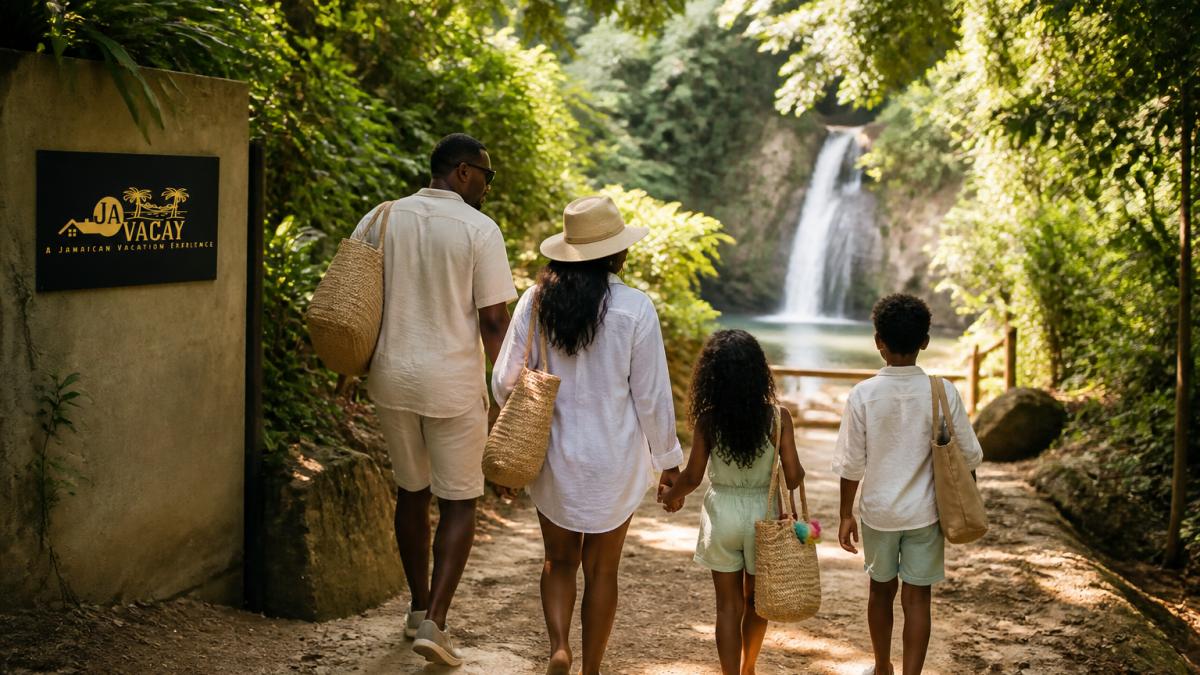
Start With What Is on the Doorstep
Start with the attractions on the doorstep. Dunn’s River Falls and Dolphin Cove are both family-friendly and minutes away, and pairing them in one morning is easy.
Then build in the practical side. A grocery run near downtown Ocho Rios, a wander through the growing Drax Hall area for modern conveniences, and a day trip toward Runaway Bay for extended coastal exploration round out a week nicely.
A Sample Low-Impact Week
This is a shape, not a schedule, shift days to suit weather and energy levels. The logic is clustering, so you are not criss-crossing the coast.
- Day one, settle in. Grocery run near downtown Ocho Rios, unpack, and let the property do its job.
- Day two, the doorstep cluster. Dunn’s River Falls and Dolphin Cove in one morning, both family-friendly and minutes away. Afternoon back at the villa.
- Day three, adventure. An early start for the Cool Blue Hole, then a slow afternoon. Early starts cut both crowds and heat.
Choosing Transport by Convenience and Impact
How you move around matters as much as where you go. There is no single right answer, but the trade-offs are worth knowing before you book.
| Option | Best for | Convenience | Likely impact |
|---|---|---|---|
| Grouped guided excursions | Families, first-time visitors | High, door-to-door, no navigation | Lower per person when the vehicle is full |
| Private driver for clustered days | Groups with mixed ages | High, flexible timing | Moderate; best when days are grouped geographically |
| Rented car | Independent explorers | Medium, parking and navigation on you | Higher if you drive scattered routes |
| Knutsford Express for island-wide legs | Longer transfers between regions | High, scheduled and comfortable | Lower than a private transfer for a single traveller |
The Knutsford Express terminal is a genuinely useful asset for island-wide travel, and using it for longer legs rather than hiring a car for every journey is one of the simplest footprint cuts available.
Booking a string of excursions scattered across the island looks adventurous on paper but turns into hours of driving and a much larger fuel footprint. Cluster your days geographically and keep one buffer day free.
How to Measure Your Trip’s Impact
You do not need a spreadsheet, but a few practical checks keep the sustainability claims honest.
- Energy: ask whether the property draws on renewable generation or battery backup, and treat air conditioning as the biggest single lever, set it a degree or two higher and use fans.
- Water: reuse towels and linen where the property allows, and ask about filtered water on site so you can refill rather than buy bottled.
- Waste: carry a reusable bottle and bag, and ask where recyclables go.
None of this requires sacrifice. Most of it saves money and time, which is why it tends to stick.
Luxury Resorts vs Private Villas: Which Fits Your Group?
For groups of six or more, a private villa usually wins on space, privacy, and value per person. Resorts win on convenience and built-in amenities. The right answer depends on how your group actually travels.
| Factor | Luxury Resort | Private Villa |
|---|---|---|
| Privacy | Shared pools and common areas | Entire home to yourselves |
| Dining | Restaurants and bars on site | Self-catering, your own schedule |
| Group space | Separate rooms, shared lobby | Shared living space, one booking |
| Flexibility | Fixed meal times, set activities | Come and go as you please |
| Local connection | Contained experience | Direct access to shops and local life |
Families with young children and elderly parents often prefer the villa model because it means one secure, gated space, a real kitchen, and no trekking through a lobby at bedtime.
If you are weighing the two directly, our comparison of private villas versus resorts in Ocho Rios lays out the trade-offs in detail, and our look at vacation rentals for large groups covers how to size a property to your party. What most guides miss is that the resort premium buys convenience, not necessarily a better holiday.
Reserve Your JaVacay Stay and Travel Lighter
We built JaVacay as a customer-friendly home with a relaxing atmosphere and a commitment to sustainable practices. Dunn’s River Falls and Dolphin Cove are just minutes away, with the Cool Blue Hole and the Luminous Lagoon also nearby, plus access to the Knutsford Express terminal.
Ready to see the home for yourself? Make a reservation and start planning a trip where the logistics take care of themselves.
Sustainable luxury travel only works when the property behind it is honest about what it does.
Frequently Asked Questions
What does sustainable luxury travel mean for a villa stay?
It means comfort and environmental care in the same booking. Ask a host which sustainability practices are in place and how they measure them. Ask a host directly what they do and how they measure it. Answers that name specific systems beat vague claims about being eco-friendly every time.
How do I choose a villa in Jamaica that is genuinely sustainable?
Ask four questions before you pay a deposit. First, what renewable or efficiency features are installed and can you see them. Second, how is waste and water managed on site. Third, how many staff are hired locally and whether the property buys from nearby suppliers. Fourth, what is included in the quoted rate so no cleaning or service charge appears at checkout. A host who answers all four with specifics is usually running a real program, not a marketing line.
Can a low-impact travel itinerary still include the big attractions?
Yes, and staying close to them is the point. A base within about 20 minutes of Dunn’s River Falls, Dolphin Cove, the Cool Blue Hole and Plantation Cove means short drives instead of long transfers. Group your days by area, use the Knutsford Express terminal for island-wide legs rather than flying, and carry a refillable bottle. You keep the waterfalls and night tours like the Luminous Lagoon while cutting the fuel, time and waste a scattered itinerary creates.
How does community-based tourism benefit local communities?
Money stays in the parish when you buy from local vendors, eat at nearby restaurants, hire community guides and stay in properties that employ neighbours. That spending supports households, schools and small businesses rather than leaking to outside operators. For travellers the payoff is practical: better local knowledge, fresher food, and access to experiences tour buses skip. Ask your host which suppliers and guides they work with, and book those directly where you can.
